Saturday, 21 February 2015

New Publication: Militia Marksmanship Training Manual (Rifle and Submachine Guns) - Type 53 Mosin Nagant, Chiang Kai-shek Mauser, Arisaka and M1903 Springfield Rifles; Type 50 (PPSh-41) and Type 54 (PPS-43) Submachine Guns.


Edwin H. Lowe Publishing is pleased to announce the publication of:

Chinese Military Manual Series No.1

Militia Marksmanship Training Manual (Rifle and Submachine Guns) - Type 53 Mosin Nagant, Chiang Kai-shek Mauser, Arisaka and M1903 Springfield Rifles; Type 50 (PPSh-41) and Type 54 (PPS-43) Submachine Guns.  

Translated and New Text by Edwin H. Lowe (Edwin H. Lowe Publishing 2015). 


Description
This book is an illustrated training manual first published in 1973 for the training of the Chinese Militia in World War II era weapons. These are the Type 53 Mosin Nagant, Zhongzheng (Chiang Kai-shek) Mauser, Type 38 Arisaka, Type 99 Arisaka and M1903 Springfield rifles; the Type 50 (PPSh-41) and Type 54 (PPS-43) submachine guns. The manual is presented as a complete and original translation.

Collectors and shooters of the rifles and submachine guns described in this book will find the manual useful. It contains the official Chinese military training instructions for the maintenance, marksmanship and field employment of these weapons, as well as data for the various weapons and ammunition types.

Of particular interest to collectors, this book features colour photographs, descriptions and translations of markings of representative Chinese Militia weapons, accessories, ammunition labels, field equipment and accoutrements described in the manual. 

About This Series
The Chinese Military Manual Series are translations of historical Chinese military manuals issued for the training of the People’s Liberation Army and the Militia.  First published in the People’s Republic of China, these are the first publically available translations of Chinese military manuals in English.


Publication Date: Feb 20 2015
ISBN/EAN13: 0994168209 / 9780994168207
Page Count: 116
Binding Type: US Trade Paper
Trim Size: 8.5" x 11"
Language: English
Color: Full Color
Related Categories: History / Military / Weapons
 
Previews
Click this link for previews of the book

US$24 + P&P 

Order Securely at the Edwin H. Lowe Publishing eStore or by Paypal


Review by Roger A. Finzel
"This book is the beginning of more than just new revelations into Chinese military preparation, arms production and use. In addition to translating The Official Chinese Militia Marksmanship Training Manual (fascinating) Edwin Lowe includes information of interest to students of Chinese modern military preparation and history. New information pops up on every page. The color photos illuminate his concise and clearly written commentaries. The descriptions of the militia organization, gun accessories, ammunition identification and Militia badges foreshadows additional information forthcoming in his soon to be published book, 'Everyone a Solider! The Chinese Militia 1958-1984'. Everyone wondering where the new China came from will be rewarded with original information and insights into this formative period of Modern Chinese history. This book is the first step that Edwin Lowe is providing in an area ignored for far too long."

Review by Bob 'Tex' Hanes
"...it is outstanding and recommend it highly if you have any interest in the Weapons of the PLA... it is a great work and will fill a space in my library."

Review by E L Baldwin
"A well written translation, easy to read with sufficient explanations & citations to understand the content. Manual covers various weapons, tactics & accessories. There is also some interesting background information concerning not only the weapons involved but also the tactical/ political/ social/ technological issues & influences of the period. This manual sits comfortably alongside the Mosin Nagant Manuals (both J F Gebhardt & T W Lapin) & The Partisan's Companion (L Grau, M Gress). Recommended reading."



Monday, 26 January 2015

When bad translation isn't just Chinglish.


While everyone loves great Chinglish, the latest update to Google Translate allowing immediate translation of speech and text (though not in Chinese), may give the impression that the days of great Chinglish might be over.  Chinglish aside, it may give the idea that translation is easier than it actually is. 

But even a reasonable fluency in both the source language and the target language, is no guarantee of a good translation. Subject matter knowledge is still critical producing a correct translation.

This translation at the Zhenhai Tower at the Guangzhou Museum is a good example of when just knowing both languages isn't enough. What are "popping cannons" and what is the "Germany kelubo weapon factory"?    The "popping cannons" are apparently "breech loading rifled 'shrapnel' guns" and the "kelubo" is the famous Krupp Company of Essen, Germany.

In a case like this, unlike the usual amusing Chinglish street sign, this translation in what is otherwise functional basic English, is practically pointless without a correct translation of the important points of interest.

Monday, 13 October 2014


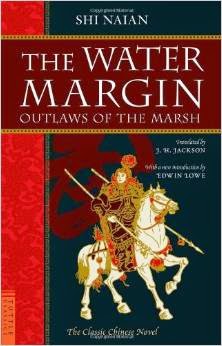
 A review of my work on 'The Water Margin' (Tuttle 2010) by Powell's Books

"This edition of the classic J. H. Jackson translation features a new preface and introduction by Edwin Lowe, which gives the history of the book and puts the story into perspective for modern readers. First translated into English by Pearl S. Buck in 1933 as All Men Are Brothers, the original edition of the J.H. Jackson translation appeared under the title The Water Margin in 1937. In this updated edition, Edwin Lowe addresses many of the shortcomings found in the original J.H. Jackson translation, and replaces the original grit and flavor of Shuihui Zhuan found in Chinese versions, including the sexual seduction, explicit descriptions of brutality and barbarity, and the profane voices of the thieving, scheming, drinking, fighting, pimping lower classes of Song Dynasty China. Similarly, the Chinese deities, Bodhisattvas, gods and demons have reclaimed their true names, as has the lecherous, over-sexed and ill-fated Ximen Qing. All of which was sanitized out when first published in 1937."

Saturday, 20 September 2014

Book Launch - When Dragons Whisper by Valerie Horniman

When Dragons Whisper - Haunted By The Shadow Of Tiananmen by Valerie Horniman, was launched on 13 September 2014.  Launching the book were Professor Kerry Brown, Director of the China Studies Centre, the University of Sydney; Professor Jocelyn Chey AM; and Dr Catherine Runcie; with Valerie Horniman and guest of honour, Ling Hou.

Dr Catherine Runcie

Prof. Kerry Brown

Prof Jocelyn Chey

Prof Jocelyn Chey


Valerie Horniman & Ling Hou

 
Valerie Horniman & Ling Hou
Valerie Horniman & Prof. Kerry Brown

Look closely!

Monday, 18 August 2014

New publication: 'When Dragons Whisper: Haunted By The Shadow Of Tiananmen'


Edwin H. Lowe Publishing is pleased to announce the publication of:
When Dragons Whisper: Haunted By The Shadow Of Tiananmen 
by Valerie Horniman, Forewords by Catherine A. Runcie and Jocelyn Chey (Edwin H. Lowe Publishing 2014).

When Dragons Whisper is now available in both colour and black-and-white print editions, as well as colour Kindle.

Buy When Dragons Whisper at the Edwin H. Lowe Publishing Bookstore.


Description:
In 1979 Australian teacher and education administrator, Valerie Horniman, began mentoring Chinese postgraduate scholars at the University of Sydney. They were the 'Gang of Nine' and were among the first scholars from mainland China to be awarded degrees at a Western university, since the establishment of the Communist government in 1949.

The 'Gang of Nine' arrived in Australia in 1979, at the very moment that China began its head long rush into 'Reform and Opening Up'. The 'Gang of Nine' had endured academic repression and personal hardships during the intellectual calamity of the Cultural Revolution. Now, they found the intellectual freedom and the intellectual rigour of a Western university, as well as life in Western society, liberating, confusing and confronting. Valerie Horniman extended her friendship, support and understanding to the 'Gang of Nine', who would become important scholars upon their return to China.

That mentorship was turned full circle in 1990, when Valerie began a new career as a teacher of English literature and Western culture to postgraduate students in Chinese universities. Valerie plunged head on into Chinese universities in the immediate aftermath of the 1989 Tiananmen Square student protests and the June 4th massacre.

Valerie arrived to find Chinese students seething with barely concealed discontent. Repression of intellectual freedom had returned to Chinese universities, as the hard line conservative leaders sought to regain control of university campuses. Yet the 'Cultural Fever' for Western thought and ideas which had gripped China since its 'opening up', was a genie that could not be returned to its bottle.

After the 1989 Tiananmen Massacre, China forged on with reform, continuing to wind back stifling totalitarian controls, while at the same time, carefully building new forms of authoritarianism over a rapidly changing society and economy. It was amidst this ambiguity and uncertainty that Valerie was given a free hand in curriculum design and content. Valerie tapped into this curiosity and thirst for Western knowledge amongst Chinese students, whilst walking on a knife edge, teaching in universities haunted by the shadow of Tiananmen.

Valerie faced vast cultural gaps between Chinese and Western culture. She bridged those gaps by drawing upon her love of Chinese literature and arts. Expertly guided by Professor Hou Weirui of the 'Gang of Nine', Valerie used the universal ideas she found in Chinese literature as a key to unlock her students' understanding of English literature and Western thought. Valerie's students studied a broad range of English literature, free from the constraints of ideologically mandated scholarship. Her students studied George Orwell's 'Animal Farm' - watching the animated film and singing 60's protest songs - on an anniversary of the Tiananmen Massacre as police patrolled the campus. Challenging and innovative, Valerie's teaching satisfied both her students' thirst for knowledge, as well as their desire to covertly express critical and taboo topics in the wake of Tiananmen.

'When Dragons Whisper - Haunted by the Shadow of Tiananmen' is Valerie Horniman's memoir, documented with colour photographs. It is the story of her seven year odyssey in China - her journeys and her teaching in a China still opening up in the wake of the Tiananmen Massacre.

Keywords:  Teaching in China, English Literature, Intercultural Teaching, Intercultural Communication, China After Tiananmen


Reviews:


"As I read of her classroom experiences, I am very much aware of how her pedagogic mandate to teach English Literature, Western Thought and Culture, and thesis preparation was constantly motivated by her unique combination of a deep love of several English literatures, Australian among them, of music and of world history plus a plucky and very Australian love of natural justice.  All this with her affection for her students who always inspired her and her love of China. After over forty years of university teaching, I still find inspiration in Val’s tales of teaching.   Her candid and caring book is a friend to China as much as to students and teachers everywhere."

Dr Catherine Runcie. 
Senior Lecturer in English Literature and Literary Theory, University of Sydney 1969-2001


"Anyone interested in how China has evolved from a doctrinaire socialist state into the present free-wheeling materialist nation that it is will find Val’s memoirs fascinating and inspiring.  Above all, she reveals the deep spiritual hunger that has resulted from the confused and confounding shifts in modern Chinese history, from communism to materialism and from isolationism to globalism."

Dr Jocely Chey AM.
Visiting Professor,  University of Sydney

Monday, 11 August 2014

In military history this week

The end of the Wanshan Archipelago Campaign of the Chinese Civil War, 7th August 1950. 

While the proclamation of the People's Republic on 1st October 1949 is what most people regard as the moment that heralds the Communist victory in the civil war, few realise that active hostilities in mopping up campaigns continued well into the late 1950s.  The Wanshan Archipelago is a chain of islands at the mouth of the Pearl River delta, stretching from Macau to Hong Kong, creating a strategic choke point. Held by Nationalist forces after the main retreat to Taiwan, the islands, flanked by Portuguese Macau and British Hong Kong allowed the Nationalists to potentially blockade the Pearl River and the critical port of Guangzhou.  A series of naval and amphibious operations by Communist forces with its headquarters in Zhongshan between May and August 1950 resulted in Communist victory despite significantly inferior naval forces.  This battle was the last major campaign against Nationalist holdouts in south China, although an active counter-insurgency campaign continued against Nationalist guerrillas well into the 1951.  It marked the final defeat of the Nationalist Party and the Republic in its spiritual home of Guangdong province.

The Wanshan Archeipelago campaign of 1950 is the third historically significant naval battles that have taken place at mouth of the Pearl River in Guangdong province in south China.  The first was the Battle of Yamen in 1279, when the Song Dynasty fought the last battle against the Mongol invasion, which resulted in the death of the last Song Emperor, Huaizong. The tomb of the Huaizong Emperor is in Shenzhen, though he is thought to have been lost at sea. The second was the Second Battle of Chuenpee during the Opium War in 1841, when the first ocean going iron steamship, the Nemesis spearheaded the British campaign, which forced south China open to trade, and ultimately, contributed to the fall of the Qing Dynasty. Much of the fighting of the opening battles of the First Opium War took place around Zhongshan.  The creek that flows past my ancestral home is marked on British Admiralty charts as 'Nemesis Creek'.

What interests me is that not only do these battle mark significant turning points in Chinese and indeed world history, but they are intimately and directly intertwined with my own family's personal histories, with the fall of the Song, the fall of the Qing and the fall of the Republic. 

It tells me that history isn't just about the great and the good. It tells me that history's hand reaches down to each of us - and connects us all to the great journey of humanity.

Edwin H. Lowe Publishing - Ideas, Research, Writing, Editing, Publishing.

Monday, 28 July 2014

When Dragons Whisper - Haunted By The Shadow Of Tiananmen


When Dragons Whisper - Haunted By The Shadow Of Tiananmen, by Valerie Horniman is the new book from Edwin H. Lowe Publishing.  Valerie's book will be launched in September 2014.

The colour edition and Kindle edition will be available on Createspace estore and Amazon. The black and white edition will be available on Createspace estore, Amazon and other bookstores.

Description:

"In 1979 Australian teacher and education administrator, Valerie Horniman, began mentoring Chinese postgraduate scholars at the University of Sydney. They were the 'Gang of Nine' and were among the first scholars from mainland China to be awarded degrees at a Western university, since the establishment of the Communist government in 1949.

The 'Gang of Nine' arrived in Australia in 1979, at the very moment that China began its head long rush into 'Reform and Opening Up'. The 'Gang of Nine' had endured academic repression and personal hardships during the intellectual calamity of the Cultural Revolution. Now, they found the intellectual freedom and the intellectual rigour of a Western university, as well as life in Western society, liberating, confusing and confronting. Valerie Horniman extended her friendship, support and understanding to the 'Gang of Nine', who would become important scholars upon their return to China.

That mentorship was turned full circle in 1990, when Valerie began a new career as a teacher of English literature and Western culture to postgraduate students in Chinese universities. Valerie plunged head on into Chinese universities in the immediate aftermath of the 1989 Tiananmen Square student protests and the June 4th massacre.

Valerie arrived to find Chinese students with barely concealed discontent. Repression of intellectual freedom had returned to Chinese universities, along with political education, as the hard line conservative leaders sought to regain control of university campuses. Yet the 'Cultural Fever' for Western thought and ideas which had gripped China since its 'opening up', was a genie that could not be returned to its bottle.

After the 1989 Tiananmen Massacre, China forged on with reform, continuing to wind back stifling totalitarian controls, while at the same time, carefully building new forms of authoritarianism over a rapidly changing society and economy. It was amidst this ambiguity and uncertainty that Valerie was given a free hand in curriculum design and content. Valerie tapped into this curiosity and thirst for Western knowledge amongst Chinese students, whilst walking on a knife edge, teaching in universities haunted by the shadow of Tiananmen.

Valerie faced vast cultural gaps between Chinese and Western culture. She bridged those gaps by drawing upon her love of Chinese literature and arts. Expertly guided by Professor Hou Weirui of the 'Gang of Nine', Valerie used the universal ideas she found in Chinese literature as a key to unlock her students' understanding of English literature and Western thought. Valerie's students studied a broad range of English literature, free from the constraints of ideologically mandated scholarship. Her students studied Animal Farm - watching the animated film and singing 60's protest songs - on an anniversary of the Tiananmen Massacre as police patrolled the campus. Challenging and innovative, Valerie's teaching satisfied both her students' thirst for knowledge, as well as their desire to covertly express critical and taboo topics in the wake of Tiananmen.

'When Dragons Whisper - Haunted by the Shadow of Tiananmen' is Valerie Horniman's memoir, documented with colour photographs. It is the story of her seven year odyssey in China - her journeys and her teaching in a China still opening up in the wake of the Tiananmen Massacre."